 listicle
10 Common Water Heater Installation Mistakes to Avoid
Table of Contents
- Water Heater Installation Code Requirements Most Homeowners Miss
- Do I Need a Permit for Water Heater Replacement?
- 10 Common Water Heater Installation Mistakes to Avoid
- 1. Improper Sizing and Capacity Planning
- 2. Wrong Venting and Exhaust Setup
- 3. Missing or Misrouted TPR Valve Discharge
- 4. Skipping Sediment Flushing and Maintenance Setup
- 5. Using Incompatible Pipe Materials
- 6. Omitting the Expansion Tank
- 7. Forgetting the Drain Pan and Discharge Routing
- 8. Skipping Startup and Commissioning
- 9. No Gas Leak or Combustion Testing
- 10. Warranty-Voiding Shortcuts
- Post-Installation Testing Checklist
- Smart Home Integration Errors
- Local Code Compliance and Permitting
- Warranty Voidance Risks
- How to Avoid These Mistakes
- Frequently Asked Questions
Last Updated: September 15, 2026
Water Heater Installation Code Requirements Most Homeowners Miss
Water heater installation is a set of code-driven steps, from permit filing to final combustion testing, that determines whether a new unit runs safely or fails inspection. This guide covers common mistakes that show up most often on failed inspections and warranty claims.
Three code areas cause most problems: TPR valve discharge (must run to a safe drain point, never capped or threaded to a hose), venting and combustion air (gas units need a correctly sized flue and enough makeup air), and seismic strapping and drain pans. Local amendments vary, so confirm requirements with your permitting office first.
Do I Need a Permit for Water Heater Replacement?
Yes, in most U.S. jurisdictions a water heater replacement requires a permit, because it involves gas, electrical, and plumbing connections that inspectors verify for safety. Some rural areas waive it for like-for-like swaps, but assume you need one.
Skipping the permit creates real problems: failed inspections at resale, voided manufacturer warranties, and liability if a leak or gas issue damages the home.
U.S. Department of Energy water heating guidance notes that proper installation affects both safety and energy performance, which is why most jurisdictions tie replacement to an inspection.
10 Common Water Heater Installation Mistakes to Avoid
1. Improper Sizing and Capacity Planning
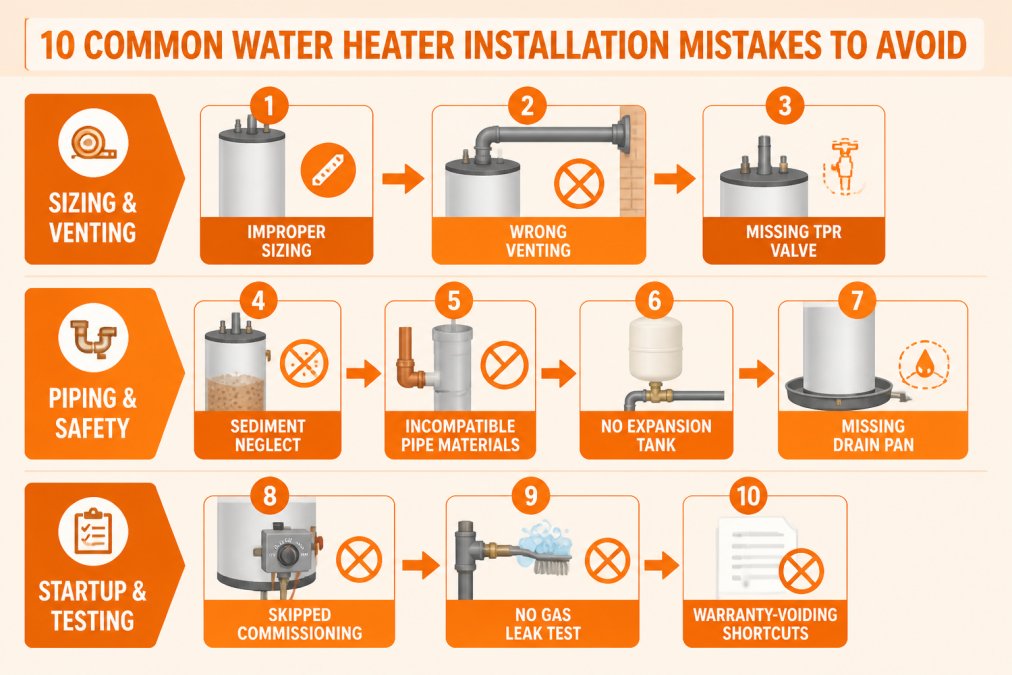
A unit sized by tank volume instead of first-hour rating will run out of hot water during morning showers. Count the bathrooms, dishwasher, and laundry schedule before picking a unit.
2. Wrong Venting and Exhaust Setup
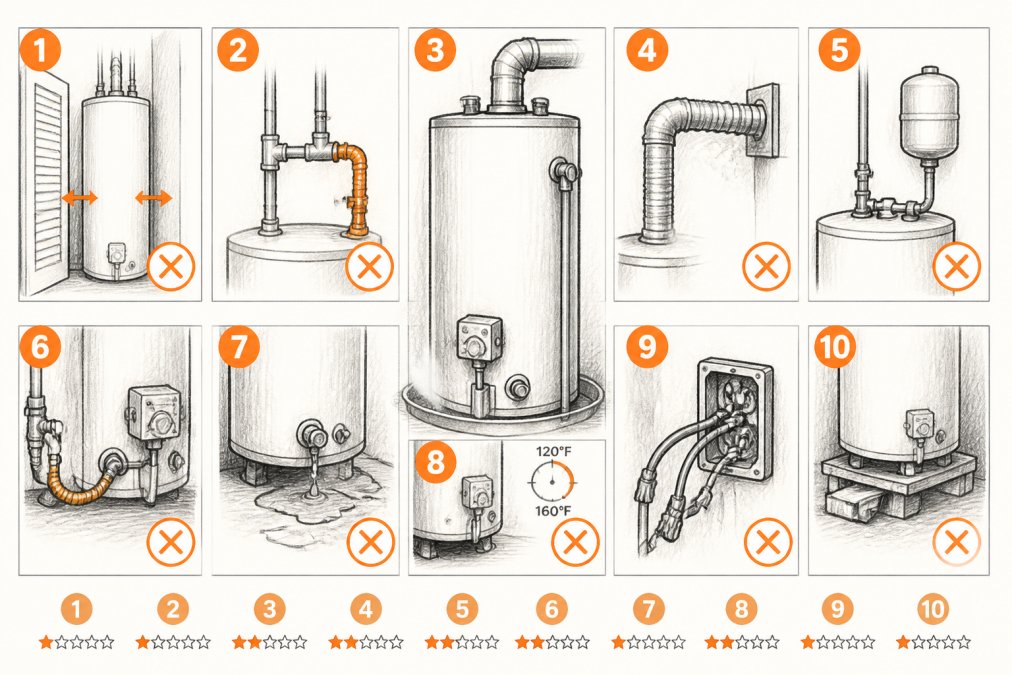
Gas water heaters need a flue matching the manufacturer's specified diameter and rise. Undersized venting causes backdrafting, where exhaust spills into the living space. Check termination height, run limits, and shared chimneys, which frequently fail inspection.
3. Missing or Misrouted TPR Valve Discharge
The TPR valve prevents a tank from becoming a projectile. Its discharge pipe must run downward, end near the floor, and never terminate where it can scald someone. Capped pipes, uphill routing, and garden-hose threading are all code violations.
4. Skipping Sediment Flushing and Maintenance Setup
Sediment buildup shortens tank life and wastes energy, starting the day the unit is filled. Skipping the initial flush and a maintenance schedule leaves a unit that fails early, and a corroded anode rod means the tank itself starts corroding.
5. Using Incompatible Pipe Materials
Connecting copper directly to a steel tank inlet without a dielectric union causes galvanic corrosion, and the joint fails within a few years, usually as a slow leak behind a wall.
6. Omitting the Expansion Tank
A closed plumbing system with a backflow preventer needs an expansion tank to absorb thermal expansion. Without one, pressure spikes stress the TPR valve, tank seams, and supply lines, a common omission in like-for-like replacements.
7. Forgetting the Drain Pan and Discharge Routing
A drain pan protects the floor and the ceiling below it. Many codes require one when the heater sits above a finished space, and most manufacturers require it for warranty coverage. Route the pan drain to a safe point.
8. Skipping Startup and Commissioning
Commissioning means filling the tank before powering it, purging air from the lines, checking the thermocouple or igniter, and confirming the thermostat setting. Skipping it burns out heating elements on electric units within minutes.
9. No Gas Leak or Combustion Testing
After connecting the gas supply line, every joint needs a leak test with approved solution or a detector.
10. Warranty-Voiding Shortcuts
Rheem's guide to common water heater installation mistakes
Post-Installation Testing Checklist
Run this before the installer leaves:
Smart Home Integration Errors
Local Code Compliance and Permitting
International Code Council on plumbing and mechanical codes
Warranty Voidance Risks
How to Avoid These Mistakes
Frequently Asked Questions
Do I need a permit for water heater replacement?
In most U.S. jurisdictions, yes. A permit triggers an inspection that verifies proper venting, TPR valve installation, and gas or electrical connections. Skipping it can void your homeowner's insurance coverage and create liability if a future sale inspection uncovers unpermitted work. A licensed plumber handles the permit as part of the job, so it is rarely something you need to chase down yourself.
What happens if a water heater is installed without a permit?
Unpermitted installations can lead to failed home inspections, forced removal and reinstallation at your expense, and denied insurance claims if a leak or fire occurs. Some municipalities also levy fines. Because the work was never inspected, hidden problems like improper venting or a missing expansion tank may go undetected until they cause damage.
What are the most common code violations for water heater installation?
The most frequent violations involve missing or improperly piped TPR valves, inadequate venting that risks backdrafting, no thermal expansion tank on a closed system, and missing drain pans where leakage would cause damage. Incorrect sizing and incompatible pipe materials that cause galvanic corrosion also show up often. Most of these are caught during the permit inspection, which is why pulling one matters.