 listicle
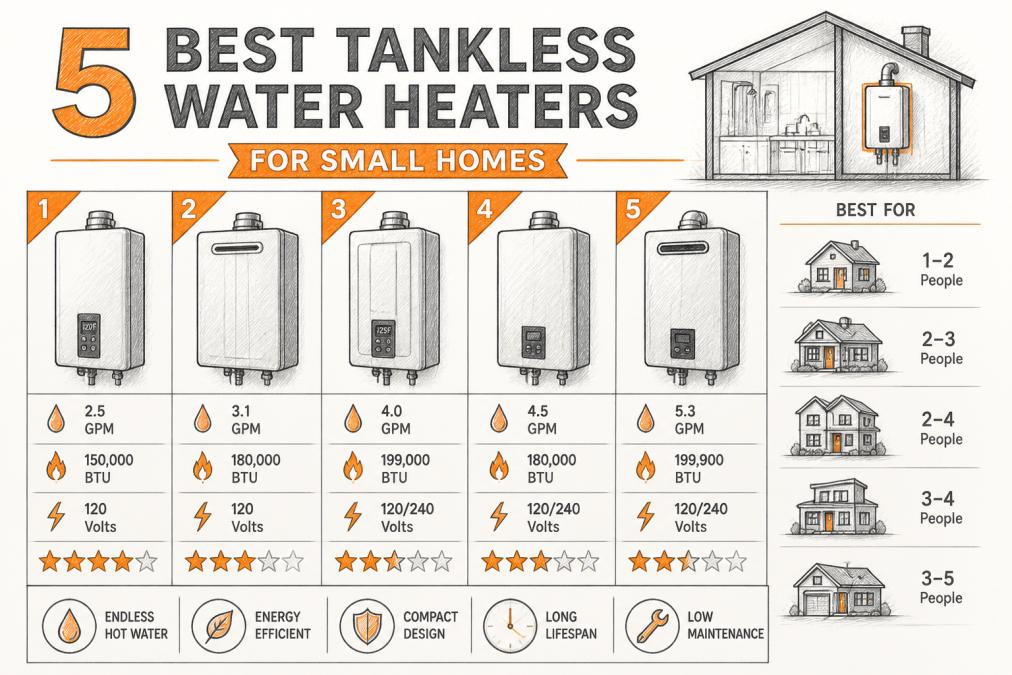
5 Best Tankless Water Heaters for Small Homes
Table of Contents
- Quick Comparison: 5 Best Tankless Water Heaters for Small Homes
- 1. Rheem RTEX-13 Electric Tankless Water Heater
- 2. Stiebel Eltron Tempra 24 Plus
- 3. Eccotemp i12 Indoor Tankless Water Heater
- 4. Rinnai RU180iN Tankless Water Heater
- 5. Navien NPE-240A2
- Electric vs. Gas Tankless: Which Fits a Small Home?
- How to Size a Tankless Water Heater for a Small Home
- Installation and Venting for Tight Spaces
- Maintenance and Descaling
- DIY vs. Professional Installation
- What Does Tankless Water Heater Replacement Cost?
- Frequently Asked Questions
Last Updated: September 12, 2026
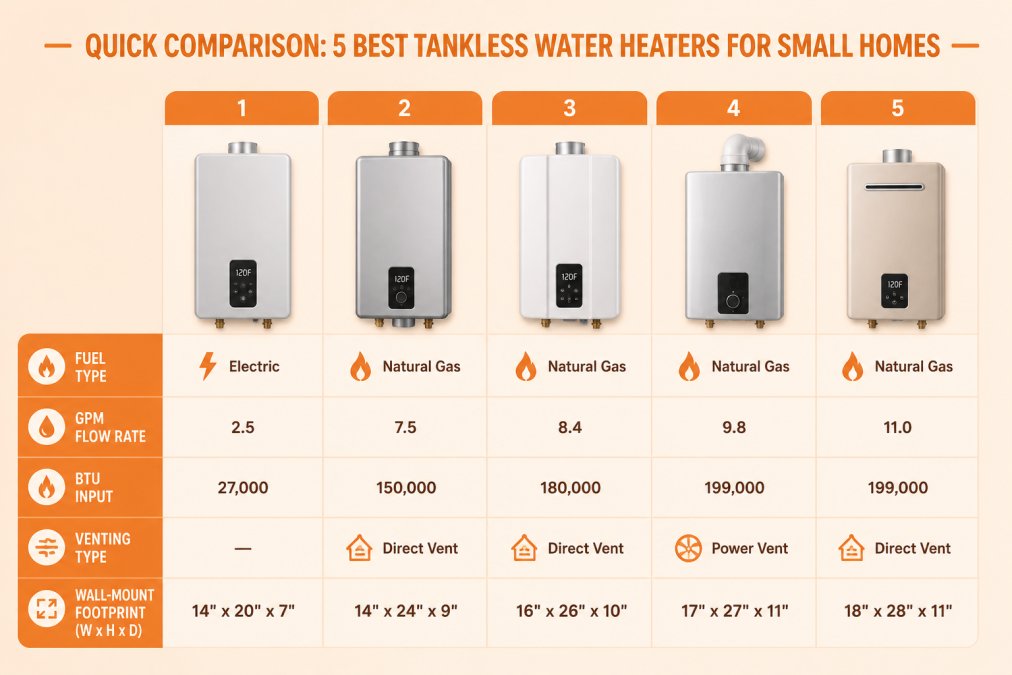
Quick Comparison: 5 Best Tankless Water Heaters for Small Homes
Small homes need the right flow rate, fuel type, and a closet-sized footprint. We ranked these five by GPM at your groundwater temperature, venting, and install footprint.
| Model | Fuel | Best For | Watch Out For |
|---|---|---|---|
| Rheem RTEX-13 | Electric | Point-of-use, one bathroom | Limited GPM for whole-home |
| Stiebel Eltron Tempra 24 Plus | Electric | Steady temperature, no swings | Needs serious electrical service |
| Eccotemp i12 | Natural gas / propane | Condos, cabins, tight walls | Professional gas line required |
| Rinnai RU180iN | Natural gas | Whole-home in a compact body | Higher upfront cost |
| Navien NPE-240A2 | Natural gas | Fast hot water, low wait | Complex install |
Tankless units are rated in GPM at a specific temperature rise. Colder groundwater means a bigger rise and lower effective flow, so match the unit to your climate, not just the spec sheet.
1. Rheem RTEX-13 Electric Tankless Water Heater
Best for point-of-use setups where you only need one fixture hot at a time. The self-modulating RTEX-13 wall-mounts almost anywhere, but flow rate is limited, run a shower and a sink at once and you'll feel it.
2. Stiebel Eltron Tempra 24 Plus
Best for small homes where temperature swings are the dealbreaker. The Tempra 24 Plus uses advanced flow control to hold steady output even when pressure shifts, but wants significant electrical infrastructure, so check your service panel first.
3. Eccotemp i12 Indoor Tankless Water Heater
Best for condos, apartments, and cabins where gas is the fuel source. The i12 is compact and wall-mounted, but requires professional gas line installation and venting planned before it goes on the wall.
4. Rinnai RU180iN Tankless Water Heater
Best for homeowners who want whole-home capacity in a compact form. The RU180iN is a condensing indoor gas unit with integrated recirculation for faster hot water and Wi-Fi monitoring. The upfront cost is higher than the electric models here; the payoff comes over years, not months.

5. Navien NPE-240A2
Best for small homes that want fast hot water with minimal wait. The NPE-240A2 is a premium condensing unit with a built-in recirculation pump and buffer tank, dual stainless steel heat exchangers, and a gas system field-convertible between natural gas and propane. Installation is complex, a job for a licensed plumber who has done it before.
Electric vs. Gas Tankless: Which Fits a Small Home?
Electric tankless units are simpler to install and don't need venting, but demand significant amperage and may require a panel upgrade. Gas units deliver higher flow rates and lower operating costs, but need venting and a gas line. For a small home, the deciding factor is usually what you already have: if gas is already run to the water heater location, a gas unit often wins on performance.
| Factor | Electric Tankless | Gas Tankless |
|---|---|---|
| Venting | Not required | Direct vent or power vent required |
| Electrical needs | High amperage, dedicated circuit | Standard outlet for controls |
| Flow rate (GPM) | Lower at cold groundwater temps | Higher, better for whole-home |
| Operating cost | Higher per unit of heat | Lower with condensing technology |
| Install complexity | Panel capacity is the wild card | Gas line and venting are the wild cards |
How to Size a Tankless Water Heater for a Small Home
Sizing comes down to two numbers: peak flow rate in GPM and temperature rise.
Add up the fixtures you might run at once: a shower is roughly 2 GPM, a kitchen sink about 1.5, a bathroom sink about 1. Then check your incoming groundwater temperature, colder regions mean a bigger temperature rise and less effective flow from the same unit.
A unit rated for a certain GPM at a 40°F rise will deliver less at a 70°F rise, so climate-specific performance matters more than the headline number on the box.
Installation and Venting for Tight Spaces
Venting requirements decide more small-space installs than dimensions do. Direct vent and power vent configurations need specific clearances from windows, doors, and corners, and condensing units produce condensate that needs a drain path. Confirm the vent run and clearance before committing to a location.
Maintenance and Descaling
Tankless units need periodic descaling to remove mineral buildup in the heat exchanger; in hard-water areas that interval shortens. Descale on the manufacturer's schedule, watch for reduced flow or temperature fluctuation as early warning signs, and keep the intake clear of dust and lint.
DIY vs. Professional Installation
Gas tankless installation is not a DIY project, it involves gas line work, venting, and code compliance, and mistakes carry real safety consequences. Electric units are more approachable, but panel capacity and dedicated circuit requirements still push many homeowners to call a professional. If you're a licensed plumber who handles this kind of work, you can apply to join our plumber network and get matched with homeowners in your area.
What Does Tankless Water Heater Replacement Cost?
Replacement pricing depends on the unit, fuel type, whether venting or electrical work is needed, and local labor rates.
Rather than guess, get a real estimate for your setup. QuickHotWater.com provides an instant online estimate and connects you with local, licensed and insured plumbers who bid competitively, so you get a fair price for quality work without overpaying or guessing. You can request an instant water heater replacement quote to see what your setup would run. The estimate is a starting point; the plumber confirms the final price on-site after bidding.
EXTERNAL_LINK: U.S. Department of Energy guidance on [tankless water heaters | energy.gov]
ENERGY STAR water heater efficiency standards
International Association of Plumbing and Mechanical Officials code resources
Frequently Asked Questions
What size tankless water heater do I need for a small house?
Add up the gallons per minute (GPM) of every fixture you might run at once, then match that total to the unit's flow rate at your local groundwater temperature. A one-bath small home often needs 6 to 8 GPM, while two bathrooms running together can push past 8 GPM. In colder climates, higher temperature rise cuts effective flow, so size up. A tankless water heater sizing guide and a licensed plumber can confirm the right capacity for your setup.
Are tankless water heaters worth it for small homes?
For many small homes, yes. Tankless units skip standby heat loss, so you only pay to heat water when a tap opens. They also free up floor space since they mount on a wall. The trade-off is a higher upfront cost and possible electrical or gas upgrades. Whether it pays off depends on your hot water habits, fuel type, and local utility rates.
What is the average cost of water heater replacement?
The average cost of water heater replacement varies widely based on fuel type, unit capacity, venting, and whether your home needs electrical or gas line upgrades. Tankless installs usually cost more than tank replacements because of added labor and materials. QuickHotWater.com gives you an instant estimate and lets local licensed plumbers bid, so you see real market pricing before committing.
Picking a tankless unit for a small home comes down to fuel type, flow rate at your climate's temperature rise, and whether your space can handle the venting. Get those three right and the rest is details. QuickHotWater.com makes the replacement itself simple: an instant estimate in about 30 seconds, a network of licensed and insured local plumbers bidding on your job, and no sales visits or spam calls. Get your estimate and let the plumbers compete for your business.