 listicle
Average Cost of Water Heater Replacement: 2026 Guide
Table of Contents
- What Drives the Average Cost of Water Heater Replacement
- Tankless Water Heater Installation Cost vs. Tank Models
- Water Heater Replacement Labor Rates Explained
- Hidden Costs Most Homeowners Miss
- Average Lifespan of a Water Heater: When to Replace vs. Repair
- DIY Water Heater Replacement Safety: What the Risks Actually Cost You
- How to Get an Accurate Water Heater Replacement Estimate
- Conclusion
Last Updated: August 10, 2026
Water heater replacement catches most people off guard, either through sudden failure or ignored warning signs. At QuickHotWater.com, we've helped homeowners understand replacement costs before a plumber arrives. The average cost varies widely based on unit type, fuel source, labor rates, and site conditions, but understanding the full picture upfront prevents sticker shock.
TL;DR:
- Tank water heaters cost less upfront; tankless units cost more but offer long-term utility savings
- Labor rates, permits, and code compliance add significantly to the unit price alone
- Emergency replacements routinely cost more than planned ones
- Federal tax credits and utility rebates can offset a meaningful portion of the total
- DIY installation carries financial and safety risks that often exceed the labor savings
What Drives the Average Cost of Water Heater Replacement
The average cost of water heater replacement combines unit price, installation complexity, local labor rates, permit fees, and code-required upgrades. Skipping any of these line items when budgeting leads to underestimates that frustrate homeowners mid-project.
Unit Type and Capacity
Unit type is the single biggest driver of upfront cost. A standard 40-gallon tank water heater sits at the lower end of the price spectrum. Heat pump water heaters carry a higher price tag than conventional electric tank models, though they consume significantly less electricity over their lifespan.
Capacity matters beyond just price. A household of four typically needs a 50-gallon tank or a tankless unit with adequate flow rate. The first-hour rating, how much hot water the unit delivers in the first hour, is the spec to check, not just tank size alone.
| Unit Type | Relative Unit Cost | Best For | Lifespan |
|---|---|---|---|
| 40-gal Gas Tank | Lower | 1-3 person households | 8-12 years |
| 50-gal Electric Tank | Moderate | 3-4 person households | 10-15 years |
| Heat Pump (Electric) | Higher | Energy-efficiency priority | 10-15 years |
| Tankless Gas | Highest upfront | Continuous hot water demand | 15-20 years |
| Tankless Electric | Moderate-High | Smaller households, limited gas | 15-20 years |
Fuel Source: Gas vs. Electric
Gas-powered water heaters generally heat water faster and cost less to operate in most regions. Electric units have lower installation complexity when no gas line changes are needed, but operating costs over 10 years can be higher depending on local utility rates.
Switching fuel types triggers a gas line conversion or electrical circuit upgrade, both adding labor and materials. A like-for-like replacement is always the most cost-efficient path when the existing setup is sound.
According to the U.S. Department of Energy's water heater guidance, fuel type affects not just operating cost but also the energy factor rating that determines long-term efficiency.
Tankless Water Heater Installation Cost vs. Tank Models
Tankless water heaters cost more to install than tank models. The unit itself is more expensive, and installation requires dedicated venting, often a new gas line of larger diameter, and potentially a new condensate drain. An electric tankless unit may require a 200-amp panel upgrade or multiple dedicated circuits.
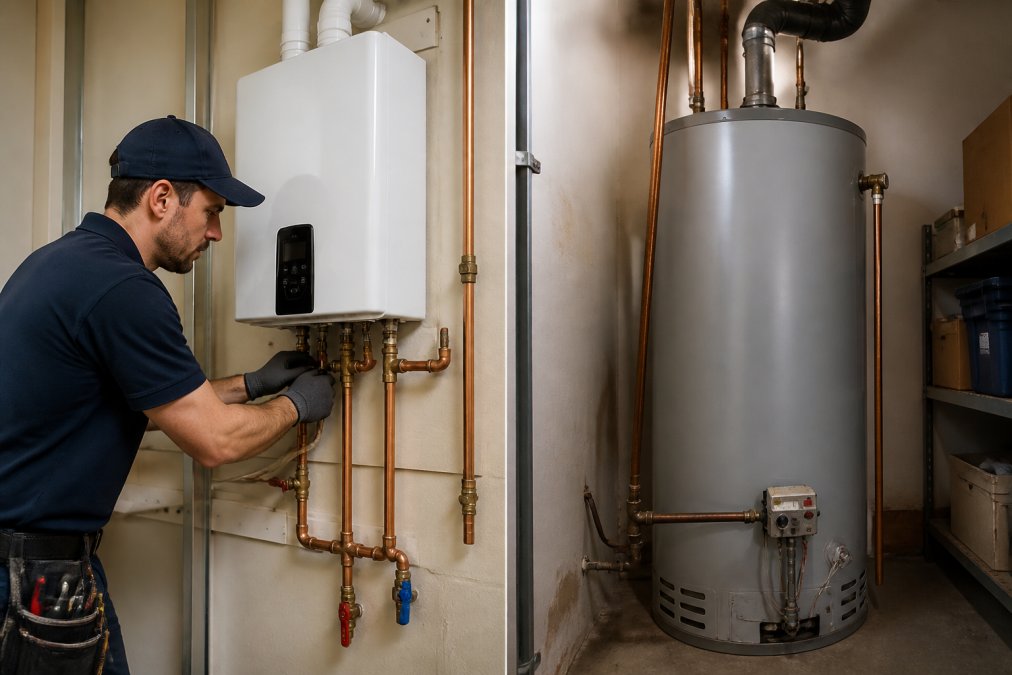
Over a 15-20 year horizon, the total cost of ownership often favors tankless. These units last significantly longer than tank models and only heat water on demand rather than maintaining tank temperature continuously.
The practical trade-off: if you're replacing a failed tank heater in an emergency and your home isn't already wired or piped for tankless, this is not the moment to switch. The additional work required extends the timeline and adds cost when you need hot water today.
| Factor | Tank Water Heater | Tankless Water Heater |
|---|---|---|
| Upfront installation cost | Lower | Higher |
| Venting requirements | Standard flue or direct vent | Dedicated, often new venting |
| Gas line requirements | Standard supply | May need larger diameter line |
| Electrical requirements | Standard circuit | May need panel upgrade |
| Hot water supply | Limited by tank capacity | Continuous, on demand |
| Lifespan | 8-15 years | 15-20+ years |
| Energy efficiency | Moderate | Higher (no standby heat loss) |
Water Heater Replacement Labor Rates Explained
Labor is frequently the line item homeowners underestimate most. A straightforward like-for-like tank replacement typically takes two to four hours for a licensed plumber. Hourly rates vary by region, and a service call fee is usually charged on top.
What pushes labor costs higher:
- Difficult access: Crawl spaces, tight closets, or upper floors require more time
- Old connections: Corroded fittings, galvanized pipe, or outdated flex connectors slow the job
- Disposal fees: Removing and disposing of the old unit is usually a separate charge
- Thermal expansion tank installation: Many codes now require this; it adds parts and labor
Permits, Inspections, and Code Compliance Costs
A permit is not optional. Most jurisdictions require a permit for water heater replacement. Permit fees are modest relative to total project cost, but the inspection that follows reveals hidden code compliance costs.
An inspector may require:
- A thermal expansion tank if one isn't already installed
- Updated seismic strapping in earthquake-prone regions
- Proper venting clearances
- A drip pan and floor drain connection
- A pressure relief valve discharge pipe routed safely
These are code requirements, not contractor upsells. A licensed plumber is obligated to bring the installation up to current standards.
Hidden Costs Most Homeowners Miss
Most cost guides stop at unit price plus labor. The actual bill often includes several additional items that are predictable once you know to look for them.
Common hidden costs:
- Expansion tank
- Flexible gas connectors
- Earthquake straps
- Permit and inspection fees
- Disposal of old unit
- Plumbing upgrades for corroded or undersized supply lines
Emergency vs. Planned Replacement
A water heater that fails on a Saturday night costs more to replace than one you schedule two weeks out. Emergency service calls carry premium rates, and urgency eliminates your ability to get competing bids.
Planned replacement, when your unit shows signs of aging but hasn't failed, gives you time to compare estimates, choose your unit, and schedule during standard business hours. The difference in total cost can be meaningful.
If your water heater is more than ten years old and showing warning signs, get an estimate now. Waiting until it fails converts a planned expense into an emergency one.
Rebates, Tax Credits, and Long-Term Savings
The federal government currently offers a tax credit for qualifying heat pump water heaters under the Energy Efficient Home Improvement Credit (Section 25C). Heat pump water heaters are among the highest-value items eligible under this program.
Many utility companies also offer rebates for replacing a standard electric resistance tank with a heat pump water heater. Checking directly with your utility provider before purchasing is worthwhile.
The long-term utility savings from a heat pump or tankless unit can be substantial over a 10-15 year lifespan. Factor in the total cost of ownership rather than just the day-one installation cost.
Average Lifespan of a Water Heater: When to Replace vs. Repair
Traditional tank models typically last 8-12 years. Tankless units can run 15-20 years with proper annual maintenance. Heat pump water heaters generally fall in the 10-15 year range.
The repair-vs-replace decision comes down to age and repair cost. A general rule: if the repair cost exceeds half the price of a new unit and the existing unit is more than seven years old, replacement is the better financial decision.
Signs you need a replacement, not a repair:
- The unit is more than 10 years old (check the serial number date code)
- Rust-colored water from hot water taps
- Visible corrosion or rust on the tank body
- Pooling water or a persistent leak around the base
- Rumbling or popping sounds during heating cycles
- Inconsistent hot water that wasn't a problem before
- Rising energy bills without a change in usage patterns
According to the U.S. Department of Energy's home energy guidance, sediment buildup in aging tank water heaters forces the unit to work harder, directly increasing energy consumption.
DIY Water Heater Replacement Safety: What the Risks Actually Cost You
DIY water heater replacement safety is serious. While disconnecting and reconnecting a water heater is manageable for a skilled DIYer, problems arise in the details.
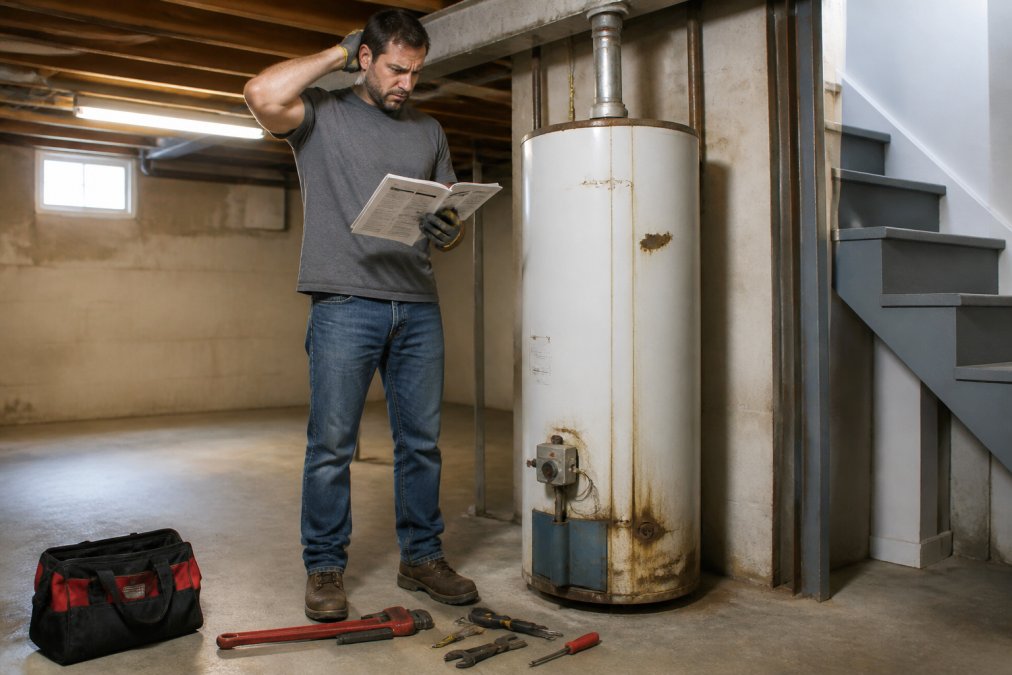
Gas line connections require leak testing with proper equipment. An improper gas connection is a fire and carbon monoxide risk. Electrical connections must comply with local code, and an unlicensed installation may void your homeowner's insurance coverage.
Permits complicate DIY further. Most jurisdictions require a licensed plumber to pull the permit. A homeowner-pulled permit is sometimes allowed, but the inspection standard is the same.
The financial risk of DIY water heater replacement:
- Voided manufacturer warranty: Most manufacturers require professional installation for warranty coverage
- Insurance exposure: An unpermitted or improperly installed unit can void coverage for water damage claims
- Rework costs: A failed inspection or improper installation costs far more to correct than the original labor savings
For a straightforward electric tank replacement in a jurisdiction that allows homeowner-pulled permits, a competent DIYer can manage the work. For gas units, venting changes, or any installation requiring code upgrades, the risk-adjusted cost of DIY is higher than hiring a licensed professional.
How to Get an Accurate Water Heater Replacement Estimate
An accurate estimate requires more than a unit price. It needs to account for your specific site conditions, local labor rates, permit requirements, and any code compliance work the installation triggers.
The most common mistake is accepting a phone quote based on unit size alone. A plumber who hasn't seen the installation site can't quote accurately. What looks simple sometimes involves corroded connections, inadequate venting, or a panel that needs upgrading.
QuickHotWater.com provides instant online water heater replacement estimates in 30 seconds, connecting homeowners with local, licensed, and insured plumbers who provide market-based bids. The platform includes permit costs in the estimate and eliminates the sales visit.
What to provide for an accurate estimate:
- Current unit type (tank or tankless) and fuel source (gas or electric)
- Tank size in gallons
- Unit location (basement, closet, garage, attic)
- Age of existing unit
- Whether you want a like-for-like replacement or a different unit type
- Any known issues with existing plumbing or venting
For planned replacements, getting two or three estimates from licensed plumbers gives you a reliable market price range. According to the Consumer Financial Protection Bureau's guidance on home repair services, homeowners who obtain multiple estimates consistently pay less than those who accept the first quote.
| Estimate Factor | Why It Matters |
|---|---|
| Site access difficulty | Affects labor hours directly |
| Fuel source change | Triggers infrastructure upgrade costs |
| Code compliance requirements | Varies by municipality and inspection |
| Emergency vs. planned timing | Affects labor rate and availability |
| Unit brand and warranty tier | Affects unit cost and long-term reliability |
A transparent, itemized estimate covering unit, labor, permit, and disposal is the baseline standard you should expect before authorizing any work.
Unexpected water heater failures are stressful, and cost uncertainty makes them worse. QuickHotWater.com removes that uncertainty by providing instant, transparent water heater replacement estimates that include permit costs, connect you with local licensed and insured plumbers, and eliminate the sales pressure that makes most home repair experiences frustrating. Whether you're planning ahead or dealing with a failure right now, get a quote from QuickHotWater.com and know your number before anyone shows up at your door.
Frequently Asked Questions
How much does water heater replacement cost on average?
Water heater replacement costs depend on unit type, fuel source, capacity, local labor rates, and site conditions. A standard 40-gallon gas or electric tank replacement typically runs less than a tankless conversion, which adds venting and gas line or electrical circuit upgrade costs. Because pricing varies significantly by region and installation complexity, the most reliable approach is to get a transparent, itemized estimate before committing to any work.
Do tankless water heaters cost more to install than tank models?
Yes, tankless water heater installation cost is almost always higher than a like-for-like tank replacement. The unit itself costs more, and installation often requires new venting, a dedicated gas line, or an upgraded electrical circuit. That said, tankless units typically last longer and use less energy, so the higher upfront investment can pay off over time through lower monthly utility bills and reduced replacement frequency.
What are the hidden costs of water heater installation?
Beyond the unit and basic labor, homeowners often encounter costs for building permits, disposal fees for the old unit, a thermal expansion tank required by current plumbing codes, gas line modifications, electrical circuit upgrades, and code-compliance corrections on existing plumbing. Emergency replacements also tend to cost more than planned ones. Getting an estimate that itemizes all these line items upfront prevents unwelcome surprises on the final bill.
Is it cheaper to repair or replace a water heater?
Repair makes sense when the unit is under eight years old, the fix is minor, and the repair cost is less than half of replacement. Once a tank water heater passes the ten-year mark, repeated service calls and declining energy efficiency usually make replacement the more cost-effective choice. A failing unit also carries water damage risk, which can far exceed the cost of proactive replacement.
Why do plumbers charge so much to replace a water heater?
Water heater replacement labor rates reflect licensing, insurance, specialized tools, permit handling, and the liability a plumber assumes for the installation. A licensed professional also ensures the work meets local code, which protects your homeowner's insurance coverage and prevents failed inspections. Platforms that connect homeowners to vetted, licensed plumbers with transparent pricing help you understand exactly what you're paying for before anyone shows up.
This article was written using GrandRanker