 how-to
Average Lifespan of Residential Water Heaters: What to Expect
Table of Contents
- How Long Do Residential Water Heaters Last?
- Signs a Water Heater Needs Replacement
- When to Replace a Water Heater (and How to Decide)
- Frequently Asked Questions
Last Updated: October 17, 2026
How Long Do Residential Water Heaters Last?
The average lifespan of residential water heaters runs about 8 to 12 years for tank models and 15 to 20 years for tankless units, depending on how the unit is built, installed, and cared for. At QuickHotWater.com, we help homeowners replace units at the end of that service life.
Tank units usually fail at the tank itself: water eats through the steel from the inside, and once a leak starts, it does not stop. Tankless units avoid standing water and last longer, though hard water and skipped maintenance shorten the gap.
Here is the range at a glance:
| Type | Typical service life | What usually ends it |
|---|---|---|
| Tank, gas | 8-12 years | Tank corrosion, sediment |
| Tank, electric | 8-12 years | Tank corrosion, element wear |
| Tankless | 15-20 years | Scale buildup, mineral fouling |
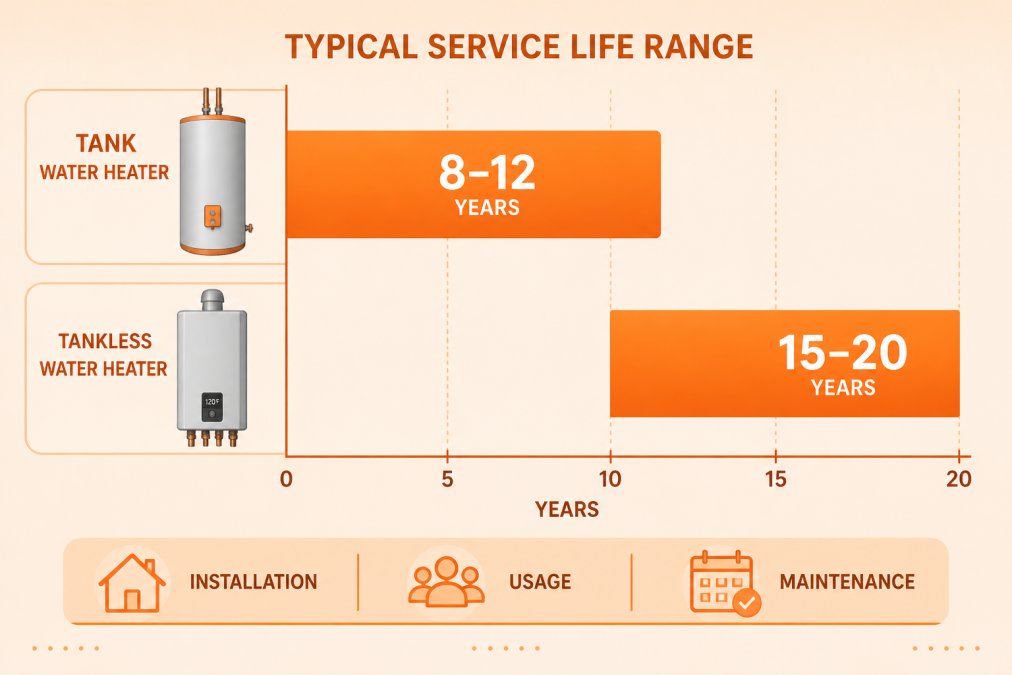
Sediment from hard water, a used-up anode rod, and poor installation or wrong sizing all push a unit toward the short end. Warranty length is a clue, but your water and care matter more.
Signs a Water Heater Needs Replacement
Watch for water on the floor, rust-colored hot water, rumbling or popping sounds, and a tank that no longer keeps up with demand. A leak at the tank is the clearest signal, and once the steel is compromised, replacement is the only real fix.
If a unit is past 10 years and starts acting up, replacing it beats pouring money into a tank on its last legs. Pin down the exact age using the serial number on the manufacturer's label.
When to Replace a Water Heater (and How to Decide)
Replace when the tank leaks, when problems pile up on an aging unit, or when the current one cannot meet your household demand. The decision comes down to age, condition, and budget.
Simple framework: a tank leaking or rusted through means replace now; past 10 years with a major failure means replace; and demand that has outgrown the unit means replace with correct sizing.
If you are weighing it, get a real estimate instead of guessing. QuickHotWater.com gives you an instant water heater replacement quote in about 30 seconds, then connects you with local, licensed, and insured plumbers who bid competitively, so you get a fair price for quality work without overpaying. The final price is confirmed on-site after bidding, so treat the instant estimate as a starting point, not a locked-in number. Permits are included in the estimate, and there is no obligation to use anyone in the network. If you are a licensed plumber looking for more replacement work, you can apply to join our plumber network.
Frequently Asked Questions
What is the average lifespan of a residential water heater?
Most residential water heaters last about 8 to 12 years, with tankless models often reaching 15 to 20 years. The exact water heater lifespan depends on installation quality, household demand, water quality, and maintenance. A unit that is sized correctly, flushed regularly, and protected from sediment buildup tends to reach the upper end of its range. If yours is past 10 years and showing rust, leaks, or inconsistent hot water, plan a replacement rather than waiting for a full failure.
How do I find my water heater's age by serial number?
Locate the manufacturer's label on the tank or near the control panel. The serial number usually encodes the production date, often as the first two digits for the year and the next two for the week. Some brands use a letter for the month. Write down the brand, model, and serial number, then check the manufacturer's website for its decoding guide. Knowing the age helps you judge when to replace a water heater before a leak causes damage.
Should I replace my water heater before it stops working?
Yes, if it is near the end of its expected life or showing warning signs like rust-colored water, rumbling noises, or moisture around the base. A planned replacement lets you get an instant estimate, compare bids from licensed and insured plumbers, and schedule the work on your terms. Waiting for a complete failure often means emergency costs and water damage. QuickHotWater.com connects you with local plumbers who bid competitively, so you can replace on your schedule without pressure.
When a water heater reaches the end of its service life, the last thing you want is a pushy sales visit or a surprise bill. QuickHotWater.com matches you with vetted, licensed, and insured local plumbers who bid on your replacement, so you see clear pricing before work begins and can plan ahead or handle an emergency. Get a quote and lock in a straightforward, like-for-like replacement without the guesswork.