 How-to
How to Read Water Heater Energy Labels: UEF, FHR, and Cost
Last Updated: November 12, 2026
Quick Summary
To read water heater energy labels, start with the yellow EnergyGuide tag, which shows fuel type, tank size, first-hour rating (FHR), Uniform Energy Factor (UEF), and estimated yearly cost. Higher UEF means greater efficiency, so compare scores only within the same fuel type and technology, and match FHR to your household size.
- The yellow EnergyGuide label takes about two minutes to read and is government-required.
- First-hour rating shows how many gallons of hot water a unit delivers in one busy hour.
- Compare UEF only within the same category, since ranges differ by technology.
- Estimated yearly cost uses a national average utility rate, so your actual cost may differ.
- Use the model number to look up ratings on the maker's site or ENERGY STAR database.
Table of Contents
- What the Yellow EnergyGuide Label Tells You
- Water Heater UEF Rating and Estimated Yearly Cost
- Water Heater EnergyGuide Label Examples and Lookup
- Frequently Asked Questions
What the Yellow EnergyGuide Label Tells You
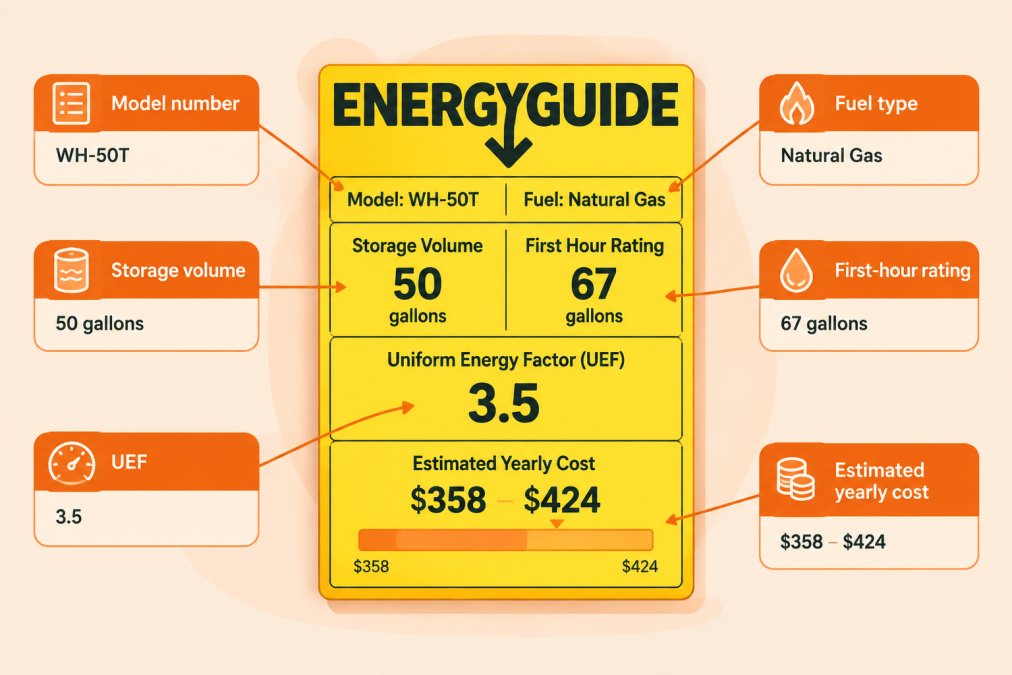
The yellow EnergyGuide label is a government-required tag showing energy use, estimated yearly cost, model number, fuel type, tank size, and efficiency rating, and water heater energy labels take about two minutes to read.
- Model number - Identifies the exact unit. Write it down before you shop so you compare like with like.
- Fuel type - Gas, electric, or heat pump. Only compare labels that use the same fuel.
- Rated storage volume - Tank capacity in gallons. Tankless units show a flow rate instead.
- First-hour rating (FHR) - How many gallons of hot water the unit can deliver in one busy hour.
- Uniform Energy Factor (UEF) - The efficiency score. Higher is better.
- Estimated yearly cost - A range based on national average use and utility rates.
The label is a comparison tool, not a promise; it assumes typical household usage, so your real bill can land above or below the printed range. The Federal Trade Commission's Appliance Labeling Rule requires manufacturers to test units under standard conditions, which is why the numbers are comparable across brands.
Water Heater UEF Rating and Estimated Yearly Cost
The water heater UEF rating is the efficiency score on the label; a higher score indicates greater efficiency. Compare within a category, since ranges differ by technology.
| Water Heater Type | Typical UEF Range | What It Means for Your Bill |
|---|---|---|
| Electric resistance tank | Lower range | Cheapest to buy, highest running cost |
| Gas tank | Mid range | Moderate upfront and operating cost |
| Tankless gas | Higher range | More upfront, lower standby loss |
| Heat pump | Highest range | Highest upfront, lowest running cost |
Estimated yearly cost is based on annual energy use and a national average utility rate, so your actual cost may differ. Compare UEF alongside price when weighing your options.
For practical ways to cut running costs on your current unit, see our guide on how to lower water heating costs at home. To compare high-efficiency models, see our roundup of the best energy efficient water heaters, our explainer on water heater energy efficiency ratings, and the benefits of upgrading to a high-efficiency water heater.
Water Heater EnergyGuide Label Examples and Lookup
The first-hour rating is also worth checking alongside efficiency, since it indicates how much hot water a unit can supply in a busy hour. Match FHR to your household size, then use UEF to pick between units that fit.
For an EnergyGuide label lookup, the manufacturer's model number is your key: search it on the maker's site or the ENERGY STAR product database to confirm the rating. Labels are most useful when compared within the same fuel type and technology.
When a label comparison points you toward replacement, you can get an instant water heater replacement quote and be matched with a licensed local plumber. The instant estimate is a starting figure; plumbers confirm the final price on-site after bidding.
Comparing labels is the easy part; finding a plumber you trust to install the unit without a sales visit or surprise markup is harder. QuickHotWater.com matches you with local, licensed and insured plumbers who bid competitively on your replacement, so you get a fair price for quality work. Permit handling is included in the estimate, and you get an instant estimate in about 30 seconds. We handle replacement only, never repair, and there is no obligation to hire anyone from our network. If you are a licensed plumber, you can also apply to join our plumber network. Get started with QuickHotWater.com and compare real bids on your water heater replacement today.
Frequently Asked Questions
How do you read a water heater EnergyGuide label?
Start at the top with the model number and fuel type so you know what you are comparing. Then read the rated storage volume in gallons and the first-hour rating, which shows how much hot water the unit delivers in a peak hour. The Uniform Energy Factor (UEF) shows efficiency, and the estimated yearly cost is based on a standardized test and national average utility rates, so your actual bill can differ.
What does the first-hour rating on a water heater mean?
The first-hour rating (FHR) is how many gallons of hot water the heater can supply in one hour starting from a fully heated tank. It matters more than tank size alone because recovery speed affects delivery. A 50-gallon tank with a strong FHR may serve a busy household better than a larger tank with slower recovery. Match FHR to your morning peak demand.
Does a higher-efficiency water heater always cost less to operate?
Not always. A higher UEF usually lowers energy use for the same hot-water demand, but operating cost also depends on your fuel type and local utility rates. A heat pump water heater with a high UEF can cost more upfront, and its savings depend on installation conditions and usage. Compare the estimated yearly cost alongside the purchase and installation price before deciding.